
Ultrafiltration (UF) & Nanofiltration (NF) Systems
Discover how UF and NF membrane technologies are transforming industrial and municipal water treatment. From reliable virus removal to heavy metal rejection, these systems deliver unmatched purity, energy efficiency, and compliance with global water safety standards.
What Are UF & NF Systems?
UF and NF are advanced pressure-driven membrane filtration processes used to remove suspended particles, pathogens, and dissolved impurities. Leveraging different pore sizes and membrane characteristics, these technologies offer scalable water purification solutions — from residential setups to industrial mega-facilities.
What is Ultrafiltration (UF)? Core Mechanics & Applications
How UF Works
Operates at low pressure (10–100 psi)
Requires minimal energy input
No chemical pre-treatment necessary
Key Applications
Pretreatment for RO systems
Potable water generation
Industrial wastewater recycling
Benefits of UF
Removes up to 99.99% of pathogens
Compact design for easy integration
Proven energy savings in pretreatment stages
Nanofiltration (NF) Explained: Precision Filtration for Complex Contaminants
NF Process Mechanics
Removes divalent ions (Ca²⁺, Mg²⁺)
Captures pesticides, organics, and microplastics
Operates at 50–150 psi
Common Use Cases
Water softening for industrial boilers
Taste/color correction in municipal supplies
Pharmaceutical-grade water production
Advantages
Selective ion rejection for tailored filtration
Better Total Dissolved Solids (TDS) control than UF
Reduced scaling potential
UF vs. NF Systems: Choosing the Right Technology
| Parameter | UF Systems | NF Systems |
|---|---|---|
| Pore Size | 0.01–0.1 microns | 0.001–0.01 microns |
| Target Contaminants | Bacteria, viruses, turbidity | Ions, pesticides, organics |
| Operating Pressure | Low (10–100 psi) | Moderate (50–150 psi) |
| Salt Rejection | None | 20–80% (divalent ions) |
Advantages of Pleated Microfiltration Membrane Cartridges
Extended Filter Lifespan: 3–5× longer than traditional depth filters due to superior surface loading.
Lower Operating Costs: Reduced change-out frequency and labor.
High Flow Rate with Low ΔP: Optimized pleat geometry ensures efficiency in high-throughput systems.
Compact Design: Fits standard housings (222, 226) without retrofitting.
Industrial UF/NF Systems: Powering Critical Sectors
1
Food & Beverage: UF for juice clarification; NF for lactose removal in dairy
2
Pharma: Bacterial endotoxin-free water for formulation and cleaning
2
3
Textiles: Dye recovery and zero-liquid-discharge (ZLD) systems
4
Municipal Utilities: Compliance with EPA/WHO potable water standards
4
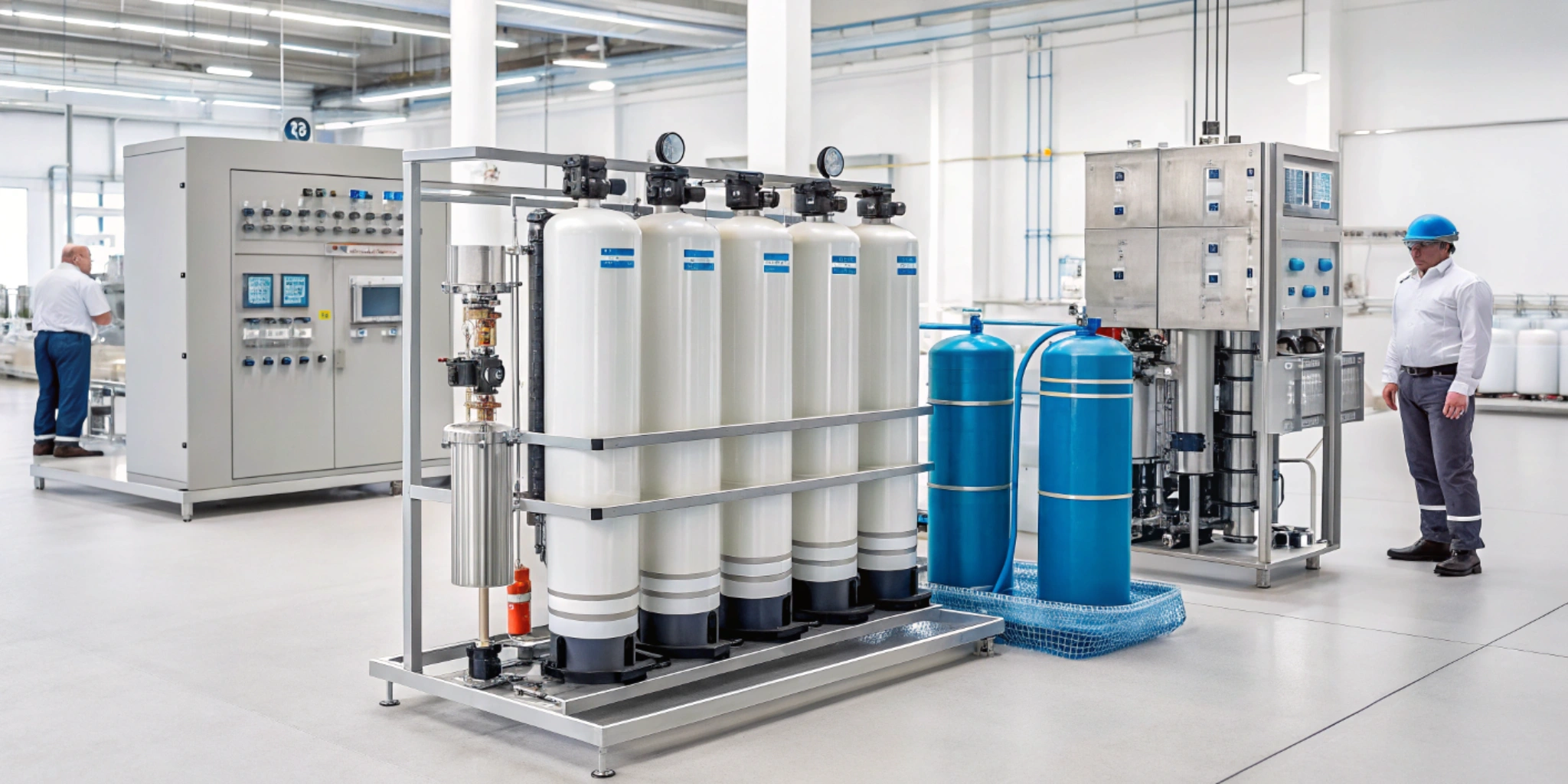
Benefits of Modern UF/NF Water Treatment Systems
Eco-Efficiency:30–50% less energy than reverse osmosis; reduced chemical dependence
Modular Scalability:Available from 1 GPM units to 1,000+ GPM industrial modules
Low Maintenance:Self-cleaning via CIP/backwash cycles improves uptime
Regulatory Compliance:Built to align with U.S. Safe Drinking Water Act and EU Directive 2020/2184
Cost-Effective ROI:Average payback in <3 years via waste reduction and reduced discharge fees
Implementing UF/NF Systems: Best Practices
Design Considerations
Feedwater Profiling: Analyze SDI, turbidity, and TDS before selecting membrane types
Hybrid Strategies: Use UF as pretreatment for NF or RO in leachate or seawater applications
Sizing for Growth: Choose modular setups that scale with demand
Maintenance & Monitoring
Periodic integrity testing
Antiscalant dosing and cleaning-in-place (CIP) cycles
Real-time monitoring of permeate flux and differential pressure
Our Range of Products
Showing all 3 resultsSorted by price: high to low

Frequently Asked Questions
What is the difference between ultrafiltration and nanofiltration?
Ultrafiltration (UF) and nanofiltration (NF) are both membrane-based water treatment processes, but they differ in pore size and target contaminants. UF membranes have larger pores (0.01–0.1 microns) and remove bacteria, viruses, and suspended solids. NF membranes are tighter (0.001–0.01 microns), filtering out divalent salts, organic compounds, pesticides, and microplastics. UF is ideal for turbidity and microbial removal, while NF is used for partial softening, color correction, and chemical contaminant reduction.
Can ultrafiltration remove viruses and bacteria from water?
Yes. Ultrafiltration systems are highly effective in removing pathogens. UF membranes typically remove 99.99% of viruses and 100% of bacteria and protozoa from water due to their pore size and physical barrier mechanism. This makes UF ideal for potable water treatment and wastewater reuse.
Does nanofiltration remove hardness and salts from water?
Nanofiltration is excellent for softening hard water by selectively removing divalent ions like calcium (Ca²⁺) and magnesium (Mg²⁺). It also reduces Total Dissolved Solids (TDS) by 20–80% depending on membrane type and operating conditions. However, for complete salt removal or seawater desalination, reverse osmosis (RO) is recommended.
How long do UF and NF membranes last, and what affects their lifespan?
Typically, UF and NF membranes last 5 to 7 years with proper care. Factors affecting lifespan include feedwater quality, cleaning frequency, operating pressure, and membrane fouling. Regular backflushing, chemical cleaning-in-place (CIP), and antiscalant dosing help extend membrane life significantly.
Are UF and NF systems suitable for industrial water treatment?
Absolutely. UF and NF technologies are widely used in industrial applications such as food and beverage processing, textile dye recovery, pharmaceutical-grade water purification, and boiler feedwater softening. Their scalability, energy efficiency, and minimal chemical use make them a preferred choice across sectors.
Can nanofiltration be used for seawater desalination?
No, nanofiltration alone cannot handle high-salinity feedwater like seawater. It’s often used as a pretreatment step before reverse osmosis (RO) to reduce scaling and remove specific organics or divalent ions. For full desalination, RO is required after NF.
What certifications or standards do UF/NF systems need to meet?
Leading UF and NF water treatment systems comply with global standards such as the U.S. EPA Safe Drinking Water Act, NSF/ANSI 61 certification, and the EU Drinking Water Directive 2020/2184. Look for third-party testing and product documentation when selecting a system.