Industrial RO Plant for Power Plants
A single silica spike can pit turbine blades and force a ₹50-lakh unplanned outage.A dual-stage reverse-osmosis (RO) train keeps silica below 10 ppb, removes ≥ 99 % salts and gases, and cuts evaporation-pond OPEX—all while positioning the station for Zero-Liquid-Discharge (ZLD) compliance.
- Manufactured in Ambattur, Chennai
- Sized to your site and water
- Installation and service support

RO Water Treatment in Power Plants: Critical Applications
Boiler Feedwater
Prevents scaling/corrosion (ASME B&PV Code Section VI).
Cooling-Tower Makeup
Dual-stage RO dropped blow-down flow by 58 % at an ABC 660 MW unit.
Turbine Steam Purity
Keeps blade-deposit silica < 20 ppb.
Flue-Gas Desulfurisation (FGD)
Provides high-purity spray water for SO₂ scrubbing.
Demineraliser Pretreatment
Triples mixed-bed resin life.
Power-Plant RO System Design Specifications
| Parameter | Thermal Power Plants | Combined-Cycle Plants |
|---|---|---|
| Capacity | 50 000 – 500 000 GPD | 20 000 – 200 000 GPD |
| Pressure | 150 – 300 psi (10 – 20 bar) | 100 – 250 psi |
| Recovery Rate | 75 – 85 % | 70 – 80 % |
| Output Quality | Conductivity < 10 µS/cm | Silica < 0.02 ppm |
Advanced RO Process for Power Industry
1
2
Clarification
Remove suspended solids (turbidity <1 NTU)
Softening
Ion exchange for hardness removal
Antiscalant Dosing
Prevent CaSO₄/Membrane scaling
Dual-Stage RO
Primary + secondary arrays for 99.7% salt rejection
Mixed Bed Polishing
Achieve <0.1 µS/cm conductivity
Decarbonation
CO₂ removal for pH optimization
3
4
4
5
6
6
Boiler Feedwater RO Systems: Technical Requirements
Materials
SS 316L or duplex-steel skids withstand 80 °C sanitisation.
Monitoring
Real-time SDI, ORP, conductivity and TOC logging
Compliance
Follows EPRI Cycle-Chemistry Guidelines.
Zero Liquid Discharge Integration
ZLD Configuration with RO
RO Concentrate → Brine Concentrator → Crystallizer → Solid Waste
RO Reject Recovery
95-98% water reuse
Cost Savings
30% reduction vs. evaporation ponds
Compliance
Five Operational Benefits of Power-Plant RO Systems

Fuel Efficiency
1 % scaling adds ~2 % fuel use; RO keeps tubes clean.

Maintenance Reduction
Eliminates acid boiler washes and downtime.

Water Conservation
60 – 75 % less freshwater intake.

Turbine Protection
Silica < 20 ppb prevents blade erosion.

Emissions Compliance
Supports mercury & arsenic capture (CCR Rule
Selecting Industrial RO Systems for Power Generation
High-Pressure Capability
Up to 1 000 psi for seawater intakes.
Automated Clean-in-Place
PLC-driven hot-water CIP extends membrane life.
Energy-Recovery Devices
Turbochargers / PX cut RO power.
Modular Skids
Drop-in retrofits for brown-field stations.
Choose with confidence
Choosing the right RO water plants
- Test the raw water first: TDS, hardness, iron and turbidity decide the pre-treatment.
- Size on peak daily demand, not on the average — and allow for future expansion.
- Ask how reject water will be reused (gardening, flushing, cooling) instead of drained.
- Choose the frame and piping material (MS powder-coated or SS) to suit the site.
- Check how often membranes, cartridges and media need attention, and who will service them.
Shop
RO Water Plants you can order online
Prices and stock shown in the shop. For bulk orders or help choosing, ask us.
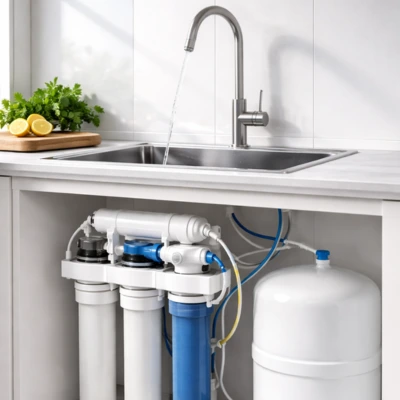
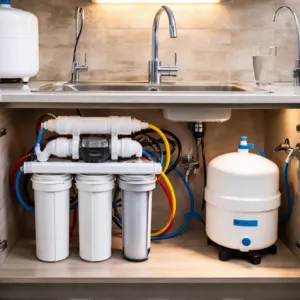


How we work
From first message to running system
- 01
Tell us the need
Share your requirement, site details and any water report or photos.
- 02
We review and size
We ask the right questions and size the system for your site.
- 03
Clear quotation
You get a quote with scope, specification and timelines.
- 04
Build, install, support
We manufacture, install, commission and stay available for service.
Related solutions
More in RO Water Plants
Questions, answered
FAQs about Industrial RO Plant for Power Plants
Still unsure? Ask us directly or call +91 95000 55565.
What silica level can RO maintain for turbine protection?
RO + mixed-bed polishing reliably delivers < 10 ppb—half the super-critical limit.
What TDS is ideal for beverage water?
• Bottled water: 10–50 ppm
• Brewing: < 100 ppm
• Soft drinks / CSD: < 10 ppm
Can RO handle seawater at coastal plants?
Yes—SWRO at 55 – 70 bar drops TDS from 35 000 ppm to < 500 ppm.
What’s the ROI on ZLD with RO?
Typical payback 2-4 years via avoided wastewater surcharges and raw-water fees.
Why use double-pass RO instead of single-pass?
Double-pass is needed for < 0.1 µS/cm conductivity in drum boilers > 1 000 psi.
How often are mixed-bed resins regenerated when RO pre-treats them?
With RO reducing ionic load, mixed-bed resins need regeneration only every 8-12 weeks—roughly one-third the frequency of non-RO systems.
How do I choose the right RO plant capacity?
Work out the treated water you need per day, divide it by the hours the plant will run, and add a margin for peaks. We confirm the capacity after reviewing your water report and usage pattern.
Do I need a water test before buying an RO plant?
Yes. TDS, hardness, iron and turbidity decide which pre-treatment the plant needs. Without a test, membranes can foul early and output drops. We can arrange a test if you do not have one.
What happens to the reject water from an RO plant?
Every RO plant produces a concentrate stream. Depending on its quality, it can be reused for flushing, gardening or floor washing. We design the plant to keep reject volume as low as the raw water allows.
How often does an RO plant need servicing?
Cartridge filters, media backwash and membrane cleaning follow a schedule set by your water quality and usage. We share that schedule at handover and offer service support after installation.
Start a conversation
Tell us what you need
Share a few details about Industrial RO Plant for Power Plants and your site. We reply on working days with questions or a quote.
Talk to a person
Speak with the Greenly team
No call centre. Your message reaches the people who design and build the system.
- +91 95000 55565
- WhatsApp +91 95000 55565
- greenly@greenly.co.in
- 101, 102 & 103 Tass Industrial Estate, SIDCO Industrial Estate, Ambattur, Chennai 600058
Visits by appointment - Open 10:00 am – 5:30 pm