
Electrodeionization (EDI) and Chemical-Free Purification
Electrodeionization (EDI) systems represent a major leap forward in water purification technology. By eliminating the need for chemicals and providing a sustainable, automated solution, EDI has become the preferred method for generating ultrapure water in industries ranging from pharmaceuticals and microelectronics to biotechnology.
What is Electrodeionization?
Electrodeionization (EDI) is a membrane-based water purification process that combines ion-exchange resins with electrical current to remove ionic impurities from water—without the need for chemical regeneration. In simpler terms, EDI acts like a self-cleaning mixed-bed deionizer, delivering consistent high-purity water (up to 18.2 MΩ•cm) with low operating costs.
EDI vs. Mixed-Bed Ion Exchange
| Feature | EDI System | Mixed-Bed Ion Exchange |
|---|---|---|
| Regeneration | Electric (no chemicals) | Chemical (acid/base) |
| Maintenance | Low | High |
| Environmental Impact | Minimal | Hazardous waste generation |
| Water Quality | Consistent, up to 18.2 MΩ•cm | Varies with resin condition |
| Operating Costs | Lower (no chemicals) | Higher (chemical handling + disposal) |
Applications of EDI Technology
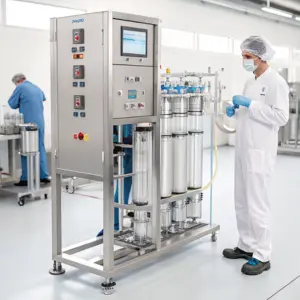
Pharmaceutical and biotech manufacturing
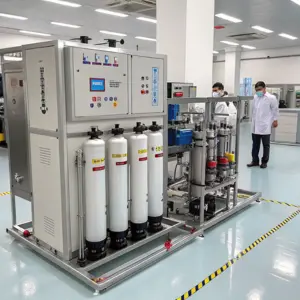
Semiconductor and microelectronics
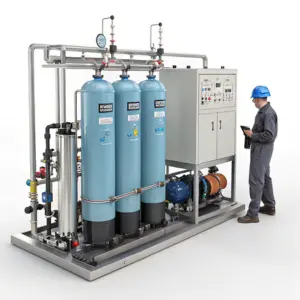
Power generation (boiler feed water)
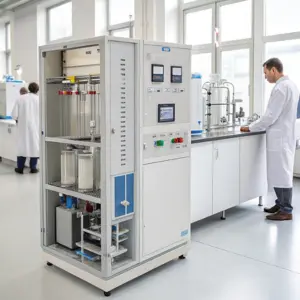
Laboratories and R&D facilities
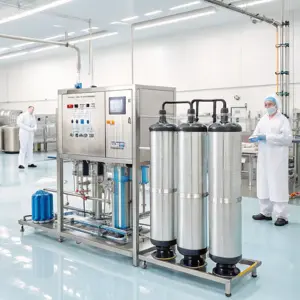
Food and beverage processing
Benefits of EDI Systems
Chemical-free operation: No need for caustic soda or hydrochloric acid.
Continuous operation: No downtime for regeneration.
Stable water quality: Up to 18.2 MΩ•cm resistivity.
Low total cost of ownership: Less labor, fewer consumables.
Scalability: Modular design supports expansion.
Environmental compliance: Supports green certifications and regulatory goals.
Choosing the Right EDI System
1
Flow Rate & Purity: Match system capacity (e.g., 10–500 GPM) to resistivity needs (5–18.2 MΩ•cm).
2
Feed Quality: Pre-treatment (RO, UF) is essential—TDS <50 ppm.
2
3
Materials: 316L stainless steel/cellulose-acetate membranes for corrosive environments.
4
Certifications: NSF/ANSI 61, CE, and SEMI-F73 for industry-specific compliance.
4
Future Trends: EDI and Sustainable Water Treatment
Renewable Integration: Solar-powered EDI units for off-grid operations.
IoT Optimization: AI-driven predictive maintenance for membrane/resin health.
Zero Liquid Discharge (ZLD): EDI concentrates recycled into crystallizers, achieving 99% water recovery.
Frequently Asked Questions
1. What is an Electrodeionization (EDI) system used for?
An EDI system is used to produce high-purity or ultrapure water by removing residual ions from reverse osmosis (RO) permeate. It is commonly used in pharmaceutical, biotech, semiconductor, and power generation industries where water quality standards are strict.
2. How does EDI differ from mixed-bed deionization?
EDI uses electrical current and ion-exchange membranes to remove ions continuously and without chemicals, while mixed-bed systems require chemical regeneration with acid and caustic. EDI is more sustainable, lower maintenance, and offers consistent water purity.
3. What level of water purity can EDI systems achieve?
EDI systems can achieve resistivity levels up to 18.2 MΩ•cm and conductivity below 0.1 µS/cm, meeting standards like USP, EP, and ASTM D5127 Type I for ultrapure water.
4. Do EDI systems require chemicals for regeneration?
No. EDI systems are chemical-free. They use electrical energy to regenerate ion-exchange resins internally, eliminating the need for acids or bases, making them safer and more environmentally friendly.
5. Is EDI suitable for pharmaceutical water systems?
Yes. EDI is ideal for producing USP Purified Water and Water for Injection (WFI) when paired with RO and appropriate pretreatment. It ensures compliance with GMP and regulatory standards for pharmaceutical manufacturing.
6. What is the required feedwater quality for EDI?
EDI requires low-TDS feedwater, typically RO permeate. The feed should be <1 ppm hardness, low in silica, and free from chlorine and organics. Pretreatment such as softening, carbon filtration, or degasification may be necessary.
7. How much does an EDI system cost?
EDI system costs vary by capacity and application, but typical systems range from $15,000 to $100,000+. While initial CAPEX is higher than mixed-bed DI, OPEX is significantly lower due to reduced chemical, labor, and downtime expenses.
8. How long do EDI systems last?
A well-maintained EDI system can last 10–15 years or longer. Maintenance includes periodic cleaning (CIP), membrane inspection, and ensuring proper pretreatment. EDI modules are durable with no resin replacement needed.
9. Can I retrofit an existing RO+DI system with EDI?
Yes. Many facilities replace traditional mixed-bed DI polishers with EDI to improve automation, reduce chemical use, and meet sustainability goals. A system audit is recommended to ensure compatibility with existing pretreatment.
10. Does EDI remove bacteria or organics?
No, EDI is designed for ionic species removal. For microbial control or TOC reduction, use complementary technologies like UV disinfection, ultrafiltration, or activated carbon filters in your system design.