
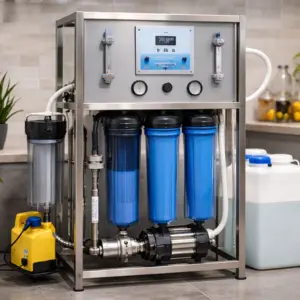
RO water plant for chemical plant
Modern chemical production processes demand water purity at levels that only specialized RO systems can deliver. Whether you're producing catalysts, solvents, or specialty polymers, using high-performance RO water filtration for chemical production is essential to prevent contamination, scaling, and inefficiencies.As a trusted reverse osmosis plant and chemical manufacturer, we build systems that are engineered to withstand corrosive environments, handle high-TDS wastewater, and meet USP, FDA, and industrial-grade water specifications. With solutions ranging from containerized batch-process RO units to fully automated ZLD-integrated plants, we help you maintain consistent water quality, reduce operational costs, and ensure regulatory compliance.

Custom RO Water Systems for Chemical Production
Chemical manufacturing requires precision-engineered RO water systems that meet aggressive feedwater conditions and strict purity benchmarks. As a trusted Reverse Osmosis Plant and Chemical Manufacturer with 20+ years of field experience, we deliver customized chemical process water RO plants featuring
Material Durability: 316L stainless steel or polymer-lined piping that withstands corrosive acids, solvents, and brine solutions with TDS up to 20,000 ppm.:
Tailored Configurations for Key Processes
Double-pass RO: Ideal for ultra-pure catalyst-grade water
Containerized units: Deployable for flexible batch operations
CIP-ready designs: Supporting pharmaceutical-grade Clean-in-Place compliance
Use Cases We Serve
High-pressure boiler feedwater preparation
Solvent dilution processes requiring <10 ppm TDS
pH-sensitive reaction water in specialty chemical synthesis
Tackling High-TDS Water Challenges in Chemical Plants
Conventional RO systems struggle with high-TDS effluents (>50,000 ppm) from dye, pesticide, or metal finishing processes. Our advanced solution delivers performance even in extreme conditions, using:

Pre-treatment
Electrocoagulation + dual media filters to remove heavy metals

Primary RO
Anti-telescoping membranes for 6,000–45,000 ppm feeds

ZLD Technology
Brine concentrators + crystallizers achieving up to 92% water recovery
Why Our Approach Works
90–98% salt rejection, including hard-to-remove chlorides and sulfates
ERDs (Energy Recovery Devices) slash power usage by 35%
Patented diamond-coated membranes resist biofouling and scaling
Applications of RO Water Filtration in Chemical Manufacturing
Our RO systems for chemical facilities meet stringent quality and regulatory needs across multiple applications
| Application | Water Purity Requirement | Recommended RO Configuration |
|---|---|---|
| Pharmaceutical CIP | <1 ppm TDS | Double-pass RO + Polishing EDI |
| Electroplating baths | <5 ppm silicates | RO with antiscalant injection |
| PET resin manufacturing | <10 ppm organics | Activated carbon pre-treatment + RO |
| Hydrogen peroxide plants | Zero heavy metals | Ceramic UF membranes combined with RO |
6 Key Benefits of Our RO Plants for the Chemical Industry
Corrosion-Resistant Construction: SS316L piping and FRP vessels built for acid/base tolerance
Chemical Synergy: Our proprietary antiscalants extend membrane life by 40%
Scalable Architecture: Expandable from 500 GPD to 50,000 GPD without layout redesign
Energy Savings: VFD-controlled pumps reduce energy usage by up to 22% per cubic meter
Regulatory Compliance: Systems validated under FDA 21 CFR Part 11 and other regional GMPs
Service & Support: Remote monitoring + certified chemical service crews available nationwide
How to Maintain Your Chemical Plant’s RO System?
Daily to Annual Maintenance Essentials
1
Daily: Check SDI (Silt Density Index) and optimize antiscalant dosing
2
Weekly: Apply non-oxidizing biocide (DBNPA) to control biofilms
2
3
Quarterly: Perform acid (citric) or alkaline (EDTA) cleanings depending on foulants
4
Annually: Replace pre-filters and test cleaning protocol effectiveness
4
Red Flags & Quick Fixes
+15% Pressure rise → Possible scaling → Increase antiscalant
10% Flux loss → Likely biofilm → Biocide flush + full CIP
TDS spike in permeate → Membrane seal failure → Inspect O-rings

Why Choose Our Chemical Process Water RO Plants?
Handle extreme TDS levels up to 100,000 ppm
Double-pass, CIP-enabled, and solvent-compatible systems
Proprietary antiscalants and biocides for maximum membrane lifespan
FDA 21 CFR Part 11 validation for pharmaceutical-grade water
Real-time monitoring, remote diagnostics & expert on-site support
Our Range of Products
Showing all 5 resultsSorted by price: high to low


Frequently Asked Questions
What type of RO system is best for chemical production facilities?
It depends on your feedwater quality and end-use. For ultra-pure needs like catalyst prep or CIP, we recommend double-pass RO with polishing stages. For general process use, a single-pass RO with antiscalants and activated carbon pre-treatment is often sufficient.
Can RO systems handle wastewater from dye or pesticide manufacturing?
Yes, with the right pre-treatment. Our systems combine electrocoagulation, carbon filtration, and specialized membranes to treat dye effluents up to 20,000 ppm TDS — achieving >93% colorant and contaminant rejection.
What chemicals are safe to use in RO systems for chemical plants?
Always use NSF/ANSI 60-certified antiscalants, biocides (e.g., DBNPA), and membrane cleaners. We provide plant-specific formulations to control scale, fouling, and pH without voiding membrane warranties.
How often do RO membranes need replacing in chemical plants?
Typically every 3–5 years, though aggressive feeds (high COD, organics, oxidizers) may shorten this to 2 years. Our remote diagnostics and performance trend analysis help you predict failures before they happen.
Do you supply ATEX-certified or solvent-resistant RO units?
Absolutely. We manufacture ATEX-rated, explosion-proof skids designed for acetone, methanol, and other volatile organic compounds. These are ideal for solvent production, petrochemicals, and fine chemical synthesis.