
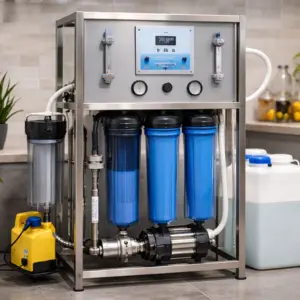


RO Water Plant
Manufacturer & Supplier of Reverse Osmosis Water Treatment Systems
An RO Water Plant (Reverse Osmosis Water Plant) is a highly efficient water treatment system designed to remove dissolved salts, chemical contaminants, heavy metals, and microorganisms from raw water. These systems are widely used for drinking water purification, industrial process water, and commercial water treatment applications where consistent water quality is critical.
As a reliable RO water plant manufacturer and supplier, we offer customized commercial and industrial RO water treatment plants engineered to meet specific water quality requirements and international standards.
What Is an RO Water Plant?
An RO water treatment plant works on the principle of reverse osmosis, where water is forced through a semi-permeable membrane under high pressure. This membrane allows only pure water molecules to pass through, while rejecting impurities such as:
- Total Dissolved Solids (TDS)
- Salts and minerals
- Heavy metals
- Bacteria and viruses
- Chemical contaminants
The output is high-purity RO water suitable for drinking, processing, and industrial use.
Working Principle of RO Water Treatment Plant
The operation of an RO plant system involves the following stages:
Pre-Treatment
Raw water is passed through:
- Multi-grade sand filter
- Activated carbon filter
- Micron cartridge filters
This stage removes suspended solids, chlorine, turbidity, and organic matter to protect the RO membrane.
Reverse Osmosis Process
High-pressure pumps push water through RO membranes, separating purified water from rejected impurities.
Post-Treatment
Depending on application, the treated water may undergo:
- UV disinfection
- Ozone treatment
- Mineral dosing
This ensures water is safe, stable, and suitable for its intended use.
Advantages of RO Water Treatment Plant
High removal efficiency for dissolved impurities
Consistent and reliable water quality
Reduces dependency on external water sources
Improves product quality in industrial applications
Cost-effective solution for large-scale water purification
Long service life with proper maintenance
Why Choose Us as Your RO Water Plant Manufacturer?
- Custom-designed RO water treatment solutions
- High-quality membranes and components
- Compliance with industry standards
- Energy-efficient system design
- Professional installation and commissioning
- AMC and after-sales service support
FAQs about RO Water Plant
1: What is the difference between a commercial and industrial RO water plant?
A commercial RO water plant is designed for low to medium water demand such as hotels, hospitals, and institutions, while an industrial RO water plant is engineered for continuous operation, higher capacities, and higher TDS levels used in manufacturing and process industries.
2: Is pre-treatment necessary for an RO water plant?
Yes. Pre-treatment is mandatory to protect RO membranes from fouling and scaling. It includes sand filtration, carbon filtration, dosing systems, and cartridge filters.
3: What maintenance is required for an RO water plant?
- Regular maintenance includes:
- Periodic filter replacement
- Monitoring pressure and TDS levels
- Chemical cleaning of membranes (CIP)
- Dosing system calibration
Proper maintenance increases membrane life and system efficiency.
4: How long do RO membranes last?
RO membranes typically last 2 to 3 years, depending on feed water quality, operating conditions, and maintenance practices.
5: How much TDS can an RO water plant treat?
A properly designed RO water treatment plant can treat feed water with TDS levels up to 10,000 ppm. Higher TDS levels may require multi-stage RO systems or additional pre-treatment.
6: What capacity RO water plant do I need?
- The required RO water plant capacity depends on:
- Daily water consumption
- Inlet water TDS
- Application (drinking or industrial)
- Operating hours per day
A technical evaluation is recommended before finalizing capacity.
7: What is the recovery rate of an RO water plant?
Typical recovery rates range between 40% and 75%, depending on feed water quality, system design, and membrane selection.