

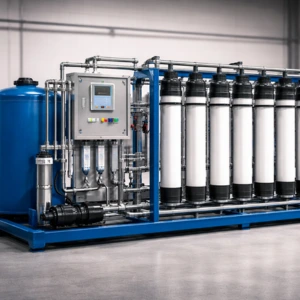
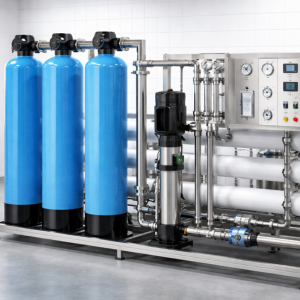
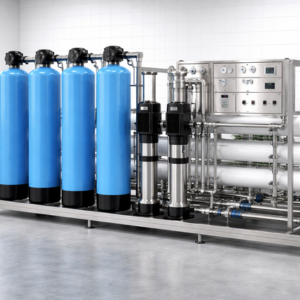
Industrial RO plant for Power Plants
A single silica spike can pit turbine blades and force a ₹50-lakh unplanned outage.A dual-stage reverse-osmosis (RO) train keeps silica below 10 ppb, removes ≥ 99 % salts and gases, and cuts evaporation-pond OPEX by up to 30 %—all while positioning the station for Zero-Liquid-Discharge (ZLD) compliance.

RO Water Treatment in Power Plants: Critical Applications
Boiler Feedwater – Prevents scaling/corrosion (ASME B&PV Code Section VI).
Cooling-Tower Makeup – Dual-stage RO dropped blow-down flow by 58 % at an ABC 660 MW unit.
Turbine Steam Purity – Keeps blade-deposit silica < 20 ppb.
Flue-Gas Desulfurisation (FGD) – Provides high-purity spray water for SO₂ scrubbing.
Demineraliser Pretreatment – Triples mixed-bed resin life.
Power-Plant RO System Design Specifications
| Parameter | Thermal Power Plants | Combined-Cycle Plants |
|---|---|---|
| Capacity | 50 000 – 500 000 GPD | 20 000 – 200 000 GPD |
| Pressure | 150 – 300 psi (10 – 20 bar) | 100 – 250 psi |
| Recovery Rate | 75 – 85 % | 70 – 80 % |
| Output Quality | Conductivity < 10 µS/cm | Silica < 0.02 ppm |
Advanced RO Process for Power Industry
1
Clarification: Remove suspended solids (turbidity <1 NTU)
2
Softening: Ion exchange for hardness removal
2
3
Antiscalant Dosing: Prevent CaSO₄/Membrane scaling
4
Dual-Stage RO: Primary + secondary arrays for 99.7% salt rejection
4
5
Mixed Bed Polishing: Achieve <0.1 µS/cm conductivity
6
Decarbonation: CO₂ removal for pH optimization
6
Boiler Feedwater RO Systems: Technical Requirements
Materials – SS 316L or duplex-steel skids withstand 80 °C sanitisation.
Redundancy – N + 1 membrane arrays for 24 / 7 availability.
Monitoring – Real-time SDI, ORP, conductivity and TOC logging
Compliance – Follows EPRI Cycle-Chemistry Guidelines.
Zero Liquid Discharge Integration
ZLD Configuration with RO
RO Concentrate → Brine Concentrator → Crystallizer → Solid Waste
RO Reject Recovery
95-98% water reuse
Cost Savings
30% reduction vs. evaporation ponds
Compliance
Meets EPA Effluent Guidelines (40 CFR Part 423)
Five Operational Benefits of Power-Plant RO Systems

Fuel Efficiency
1 % scaling adds ~2 % fuel use; RO keeps tubes clean.

Maintenance Reduction
Eliminates acid boiler washes and downtime.

Water Conservation
60 – 75 % less freshwater intake.

Turbine Protection
Silica < 20 ppb prevents blade erosion.

Emissions Compliance
Supports mercury & arsenic capture (CCR Rule
Selecting Industrial RO Systems for Power Generation
High-Pressure Capability – Up to 1 000 psi for seawater intakes.
Automated Clean-in-Place – PLC-driven hot-water CIP extends membrane life.
Energy-Recovery Devices – Turbochargers / PX cut RO power by 35 %.
Modular Skids – Drop-in retrofits for brown-field stations.
Our Range of Products
Showing 25–28 of 28 resultsSorted by price: high to low

Frequently Asked Questions
What silica level can RO maintain for turbine protection?
RO + mixed-bed polishing reliably delivers < 10 ppb—half the super-critical limit.
What TDS is ideal for beverage water?
• Bottled water: 10–50 ppm
• Brewing: < 100 ppm
• Soft drinks / CSD: < 10 ppm
Can RO handle seawater at coastal plants?
Yes—SWRO at 55 – 70 bar drops TDS from 35 000 ppm to < 500 ppm.
What’s the ROI on ZLD with RO?
Typical payback 2-4 years via avoided wastewater surcharges and raw-water fees.
Why use double-pass RO instead of single-pass?
Double-pass is needed for < 0.1 µS/cm conductivity in drum boilers > 1 000 psi.
How often are mixed-bed resins regenerated when RO pre-treats them?
With RO reducing ionic load, mixed-bed resins need regeneration only every 8-12 weeks—roughly one-third the frequency of non-RO systems.