

RO water plant for steel manufacturing
In steel manufacturing, water is not just a resource – it's an essential raw material. Contaminants in feed water can lead to catastrophic scaling in cooling systems, pitting in rolled steel, and corrosion in boilers. With tightening global environmental regulations and shrinking profit margins, industrial RO plants for steel manufacturing have evolved from a luxury to a necessity. This page reveals how precision-engineered RO systems eliminate production risks, boost operational efficiency, and help steel plants save 25-40% on operational costs.
How Our RO Systems Solve Critical Steel Factory Water Challenges
Patented 5-Stage Treatment Process

Pre-filtration
Removal of suspended solids such as blast furnace slag and iron particles.

Antiscalant Dosing
Prevents membrane fouling from high-TDS scrubber wastewater.

High-Pressure RO
Achieves 99% rejection of dissolved salts, heavy metals, and silica.

EDI Polishing
Ensures <0.1 µS/cm conductivity for boiler feedwater.

Sludge Management
Concentrates effluent into recyclable cake, perfect for use in cement plants.
Steel-Specific Innovations
Scaling Immunity™ Membranes: Designed to resist iron fouling from coke oven gas scrubbers.
Adaptive Recovery Controls: Automatically adjust to fluctuating TDS (500–15,000 ppm).
Advanced Effluent Treatment RO: Zero Liquid Discharge for Steel Plants
ZLD Architecture for Steel Effluents

Performance Metrics
| Parameter | Input | RO Output | Reuse Standard |
|---|---|---|---|
| TDS | 8,500 ppm | 120 ppm | ASTM D4195 |
| Hardness | 2,800 ppm | 8 ppm | ✓ |
| Silica | 220 ppm | 0.8 ppm | ✓ |
| Water Recovery | - | 78–82% | ZLD Compliant |
Custom-Engineered RO Plants for Heavy Industries
Steel-Tailored Configurations
Modular Skids: Bolt-on capacity expansion from 10 m³/hr to 500 m³/hr.
Material Science:FRP pressure vessels for acidic pickling line wastewater.Titanium impellers in high-chloride environments.
Hybrid Solutions: RO + electrocoagulation for oily cold rolling mill effluent.
Operational Benefits of RO Water Treatment in Steel Production
1
Cost Compression:40% lower maintenance compared to traditional softening systems.$8–$12 saved per 1,000 gallons recycled water.
2
Quality Enforcement:Near-zero ppm dissolved solids → defect-free continuous casting.
2
3
Downtime Elimination:22,000+ hours membrane lifespan in scaling environments.
4
Sustainability Compliance:Achieve 0.5 m³/ton water consumption (compared to the industry average of 3.5 m³/ton).
4
Selecting Your RO Plant: Pharma Industry Requirements
Ruggedized Design Parameters
Flow Rates: 5–500 m³/hr (customizable).Pressure Tolerance: 150–1,000 psi (acid-resistant housings).Membrane Type: Polyamide TFC, pH stable (2–11).
Automation
Real-time SDI monitoring.AI-driven antiscalant dosing.Remote O&M dashboards for seamless operations.
Certifications
ASME Section VIII, PED 2014/68/EU, EN 10204-3.1
Our Range of Products
Showing all 5 resultsSorted by price: high to low
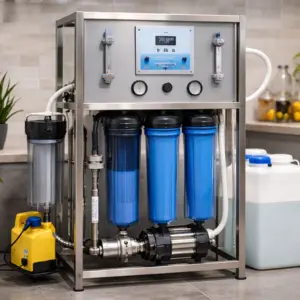


Why Steel Manufacturing Demands Industrial RO Plants
Scaling Sabotage: High calcium/silica levels in water form rock-hard deposits in cooling towers and heat exchangers, leading to 30% energy waste and unplanned downtime.
Quality Killers: Dissolved ions (Fe²⁺, Cl⁻) cause surface defects during quenching and hot rolling, contributing to product rejection rates up to 15%.
Corrosion Crisis: Sulfates and chlorides in boiler feedwater corrode pipelines, causing leaks, safety hazards, and early equipment replacement within 5 years.
Frequently Asked Questions
Can RO handle blast furnace gas scrubber wastewater?
Absolutely. Our systems include MnO₂ filters for H₂S removal and CIP-enabled membranes for fouling recovery.
What’s the ROI timeline for a 100 m³/hr plant?
14–26 months, thanks to:
• 90% reduction in downtime costs
• 65% lower wastewater hauling fees
• 30% energy savings in boilers
How do you manage high-iron feed water?
Three-stage approach:
• Oxidation + filtration (Fe²⁺ → Fe³⁺)
• Antiscalants with iron dispersants
• 6-month membrane cleaning cycles